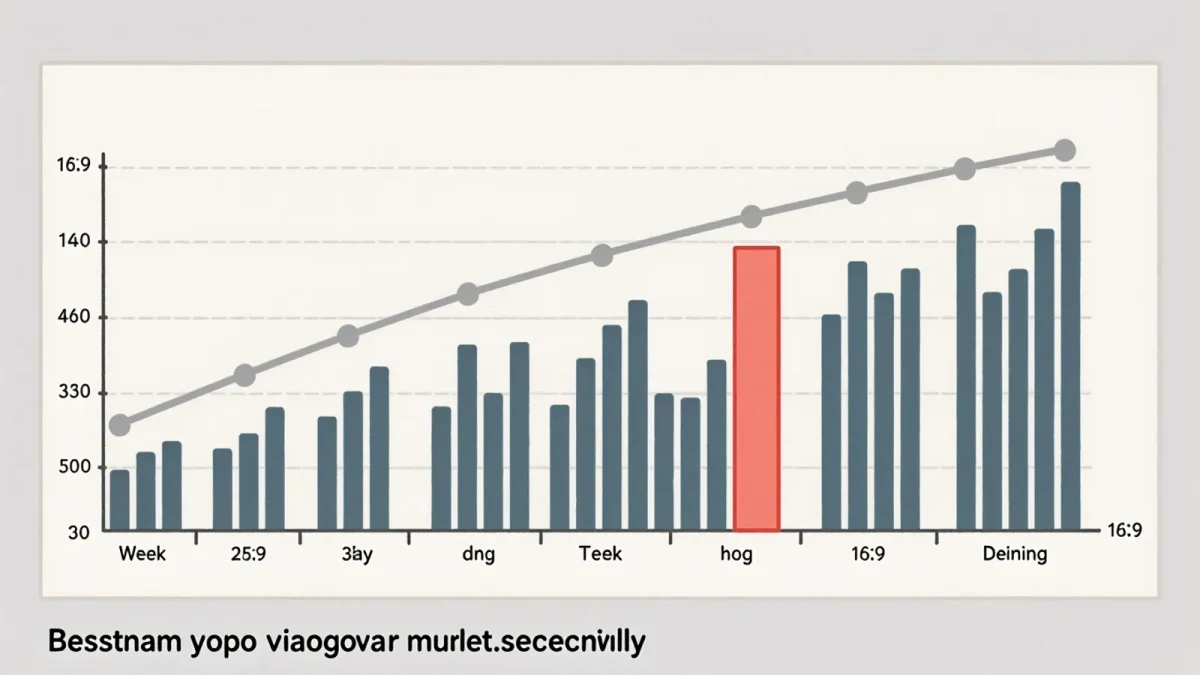
The acute-to-chronic workload ratio (ACWR) — this week's training load divided by your recent four-week average — became one of the most widely used numbers in elite sport after research popularized by Tim Gabbett reported that big spikes in the ratio were followed by markedly higher injury rates in professional rugby league players. Then came the audit: a 2020 methods critique by Marco Impellizzeri and colleagues, published with follow-up work through 2021, argued the ratio is mathematically noisy, its apparent predictive power largely an artifact of how it is computed, and its cut-offs arbitrary. The honest position as of 2026: rapid load increases do precede injuries in many team datasets, but the specific ACWR number on a dashboard should be read with suspicion.
ELITE SPORTS MAG publishes information, not medical advice. Injury concerns belong with qualified professionals.
Where did ACWR come from?
From training-load science of the 2010s. Researchers modeled injury risk as a function of the relationship between what an athlete did this week (acute load) and what they had built up to over the previous month (chronic load). Gabbett's studies of professional rugby league squads reported that when acute load substantially exceeded chronic load — commonly cited as a ratio above about 1.5, with a sweet spot between roughly 0.8 and 1.3 — injury risk in the following week climbed sharply. The framework spread through elite sport because it was intuitive, computable from any load metric, and offered a dashboard-friendly single number.
What does the ratio look like in practice?
The mechanics, stripped down:
- Acute load: training completed in the last 7 days, typically session distance, high-speed running meters or a session-RPE load score (rating of perceived exertion multiplied by minutes).
- Chronic load: a rolling average of the last 28 days.
- Ratio: acute divided by chronic. A ratio of 2.0 means this week doubled the monthly norm; 0.5 means the athlete did half.
Practitioners used the bands as guardrails — flag ratios above about 1.5 for extra monitoring, treat chronically low ratios as underpreparedness.
Why did researchers turn on it?
For reasons that hold up under examination. Impellizzeri's critique, elaborated in a series of papers and commentaries through 2020 and 2021, made several arguments. First, the ratio uses same-week data on both sides of a regression: this week's load appears in both numerator and denominator, manufacturing a mathematical association with anything caused by load — injuries included. Second, injury itself changes the ratio, since injured athletes stop training: an injury can cause a low ratio as easily as a high ratio can precede injury, scrambling causal reading. Third, the published cut-offs (0.8, 1.3, 1.5) were post-hoc divisions of noisy data, not validated thresholds; re-analyses found different datasets produce different optimal bands. And fourth, ratio metrics in general behave badly — two athletes with identical ratios can have entirely different absolute loads, which is the thing physiology actually responds to.
So was the load-injury relationship wrong?
No — and this is the important separation. The claim that survived is simpler and older: large, rapid increases in training load are associated with elevated injury risk in the following days to weeks, an observation replicated across sports and load metrics, and consistent with tissue-adaptation logic: load rises faster than tissue remodels, and something gives. What did not survive is the claim that one specific ratio formula captures that relationship cleanly or predicts individual injuries usefully. Prediction, the critics emphasized, is the wrong test anyway: even the original studies predicted little individual-level injury risk — population-level associations, not athlete-specific forecasts.
Related stories: The Habits That Extend Athletic Careers · Early Specialization vs. Multisport: What Research Says.
How do teams monitor load now?
The practical synthesis most practitioners landed on after the critique:
- Track absolute load and week-to-week change in absolute terms, not only ratios.
- Respect progressions — many programs cap weekly increases in the range of 10 to 30 percent depending on the athlete's base.
- Keep chronic load adequate: well-conditioned athletes absorb spikes better, a finding that predates and survives ACWR.
- Treat any single number — ratio, GPS distance, readiness score — as a conversation starter with the athlete, not a verdict.
What should ordinary athletes take from this?
The usable core: build gradually, keep a base under you before you add intensity or volume, and expect the biggest injury-risk windows after jumps — the first spike of pre-season, the sudden hill week, the race you signed up for on a whim. Whether your app shows an ACWR of 1.4 or 1.6 is close to meaningless at the individual level; whether you doubled your mileage last week is not. The general principle is well supported; the precision is a story we told ourselves.
Which load metrics do teams actually use?
Three families dominate. External load — what happened to the athlete — is measured with GPS distance, high-speed running meters, sprint counts and accelerometer loads, standard in professional soccer, rugby and Australian football. Internal load — what the athlete felt — is captured by session-RPE, the perceived-exertion score multiplied by minutes, which remains the most widely used metric in team sport precisely because it needs no hardware. Wellness and readiness questionnaires sit in between, and heart-rate variability adds an overnight recovery signal some teams weigh. The ACWR critique applies to all of these when they are ratio-ed: the metric choice matters less than practitioners assumed, because any load number plugged into the same arithmetic inherits the same artifacts.
What replaced the ratio in practice?
Not a single successor — a posture change. Teams that published or discussed their post-critique methods describe more absolute-number monitoring (this week's total against last week's), more individualization (changes judged against each athlete's own baseline and history, not squad bands), and heavier weight on conversations and non-load factors — sleep, stress, prior injury, age — that the ratio era flattened out. Rolling averages survived in friendlier forms: chronic load as a fitness proxy is still useful, an idea older than ACWR, and week-to-week percentage change is still screened, just without pretending to be a validated injury probability. The critique's practical legacy is smaller dashboards and bigger judgment calls.
Can load monitoring predict illness as well as injury?
Partially, with the same caveats. Training load relates to immune function along a J-curve described in exercise-immunology research: moderate activity supports immune health while sustained heavy blocks transiently raise respiratory-infection risk — the classic studies of marathon and ultramarathon runners found elevated post-race illness rates in the days after events, while moderate regular exercisers reported fewer infections than sedentary peers. Load-monitoring systems in elite sport do track illness spikes alongside load, but the predictive mathematics has the same limits as the injury version: association at squad level, weak for the individual. Sleep, travel and stress dominate illness risk as much as mileage does.
The short version
Load monitoring is worth doing and the spike-injury association is real at the group level. The specific ACWR formula that made dashboards look scientific is on shaky mathematical ground, and its cut-off numbers deserve none of the authority they acquired. Monitor load; distrust false precision.
For more context, read The Habits That Extend Athletic Careers.
For more context, read athlete retirement transition.
For more context, read Sleep and Athletic Performance: What Teams Track.