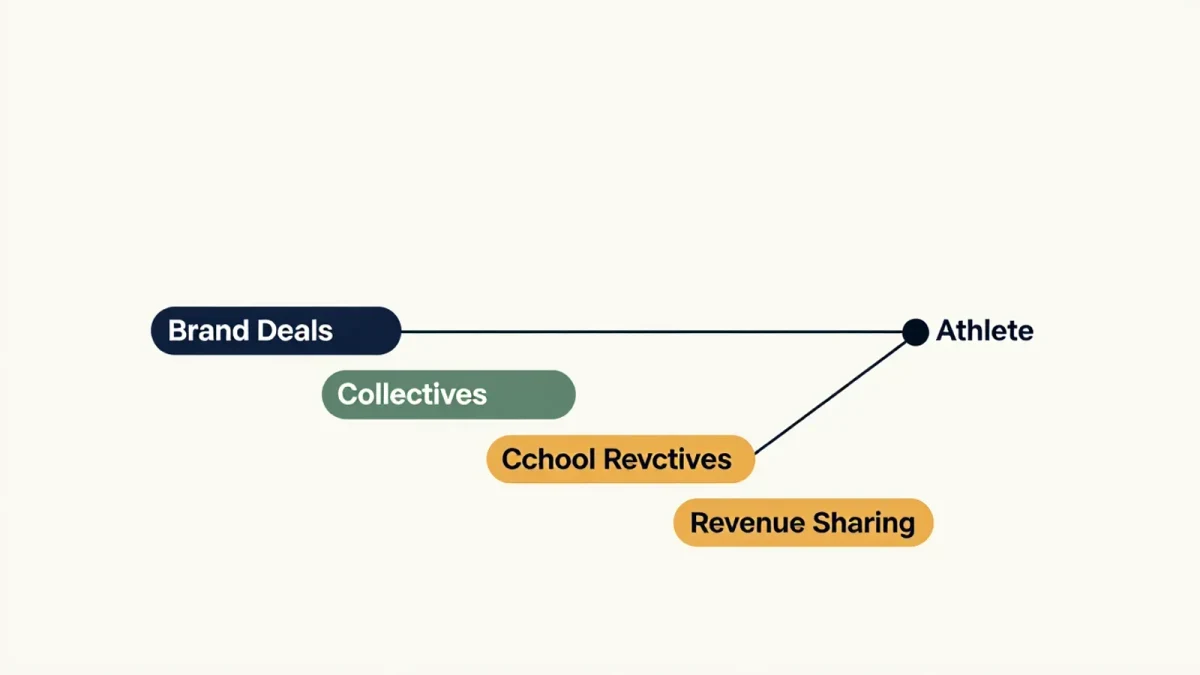
Name, image and likeness (NIL) rules let college athletes earn money from endorsements, appearances and social content without losing eligibility — a right they gained nationally on July 1, 2021, when the NCAA adopted its interim policy days after state laws forced the question. The economics then split in two: outside deals with brands and collectives, and since July 2025, direct revenue sharing from schools themselves under the House v. NCAA settlement, which allows power-conference athletic departments to distribute roughly 20 million dollars per school per year to athletes. As of May 2026, both channels run in parallel, and the market is still settling.
ELITE SPORTS MAG publishes information, not legal advice. Athletes and businesses negotiating NIL deals should consult qualified professionals.
What changed in 2021?
Before July 1, 2021, NCAA amateurism rules barred athletes from accepting money tied to their athletic fame — a restriction that had come under legal and state-legislative pressure for years. When several state NIL laws were about to take effect simultaneously, the NCAA adopted an interim policy permitting NIL compensation, and athletes across divisions signed endorsement deals within days. The market's first phase followed a pattern documented in industry tracking data from firms such as Opendorse: a steep power-law distribution, with football and basketball stars at the top, and most athletes earning modest amounts from local businesses, camps and social posts.
What are collectives?
Collectives are booster-funded organizations — typically independent nonprofits or LLCs aligned with a school — that pool donor money and route it to athletes through appearances, licensing and promotion deals. By the mid-2020s they had become the dominant NIL channel at power-conference schools, with aggregate spending across Division I estimated in the hundreds of millions of dollars per year by NIL tracking firms. Their legal status sat in a gray zone between donor support and pay-for-play, which is precisely the ambiguity the House litigation targeted.
What did the House settlement change?
House v. NCAA, an antitrust class action, ended in a settlement approved by a federal judge in June 2025. Its core terms, as reported by the Associated Press and other outlets covering the case: schools in the top division may now share a capped pool of revenue with athletes directly — about 20.5 million dollars per school per year at the start — funded primarily from media-rights and ticket income; roster limits replaced scholarship caps in many sports; and a separate back-pay fund addressed prior athlete claims. The effect on the athlete side is a third income channel layered on top of NIL deals: employment-adjacent compensation without athletes being classified as employees.
How does the money actually flow now?
A simplified map of the channels as of the 2025-26 academic year:
| Channel | Who pays | Typical size |
|---|---|---|
| Brand endorsements and social content | Companies directly | Small local deals to seven-figure national contracts |
| Collective deals | Booster-funded collectives | Roster-building payments, mostly in revenue sports |
| Revenue sharing | University athletic departments | Capped pool, roughly $20.5M per school per year |
Who actually earns the most?
The same athletes who draw the audiences. Industry data consistently show football and men's basketball accounting for the large majority of collective and revenue-share dollars, with women's sports — notably basketball and volleyball through strong social followings — outperforming their share of traditional media money in the endorsement market. Opendorse's published rankings through 2025 have shown women athletes holding several of the top endorsement positions by social engagement. A small group of Olympians and social-first personalities earn more from brand deals than from sport itself.
Related stories: ACL Injury Prevention in Female Athletes: What Works · Early Specialization vs. Multisport: What Research Says.
What are the open questions?
Several, as of the 2025-26 season. Whether revenue sharing ends the collective era or merely changes its function — many collectives redirected funds toward sports that lose money under the caps — remains unresolved. Regulation is patchy: state laws, NCAA rules and federal proposals (a NIL bill has repeatedly circulated in Congress without passing) overlap inconsistently. Agent involvement, transfer-portal timing and deal enforcement are handled by a mix of school compliance offices and state laws. And the revenue-share cap is set to rise with future media deals, meaning the numbers in any article age quickly — including this one.
How do taxes and compliance actually work?
NIL income is ordinary income in the eyes of tax authorities — a point player associations and industry advisors repeat because first-time filers are often surprised by it. An athlete signing deals across multiple states can owe taxes in each state where work is performed, which is why the advisory layer around NIL grew so quickly. On compliance, the burden sits with the school: athletic departments review deals for conflicts with team contracts and institutional policy, and state laws layer their own disclosure or registration requirements on top. The detail most often missed: payments tied to athletic performance or enrollment inducements remain restricted under settlement-era rules, so deal structure — what the payment is nominally for — matters legally as much as the amount.
What is happening at the high-school level?
A patchwork, with real stakes. State high-school associations set their own NIL rules, and as of the 2025-26 school year the map is split: many states permit high-school athletes to sign NIL deals while retaining eligibility, while others prohibit them or restrict them to cases where the athlete has signed with an institution in a state that allows it. The practical consequence for families is that one recruiting decision — which association governs the athlete — can change what deals are legal, and recruiting-focused media have documented athletes transferring associations partly over this. The NCAA's own rules do not apply until enrollment, which is where most of the confusion starts.
How does NIL interact with the transfer portal?
Closely, and mostly through money timing. The transfer portal — the mechanism letting athletes switch schools with broad eligibility flexibility — created a free-agency-like market that NIL accelerated: collectives and schools negotiate with portal athletes in recruiting windows, sometimes weeks before decisions. Settlement-era reforms tried to add structure, including transfer windows and, under the 2025 rules, expectations that athletes sit out a year after a second transfer unless a waiver is granted. Empirically, the portal era has produced record transfer volumes in football and basketball, and roster-management research across programs now treats retention economics — what it costs to keep a starter — as a core budget line.
The short version
NIL turned college athletes into endorsers in 2021; the House settlement made them revenue participants in 2025. The market now has three channels — brands, collectives, schools — governed by overlapping rules that still shift. For training-minded readers, the meaning is simpler: the best college athletes now have real economic reasons to treat their bodies, sleep and availability as professional assets.
For more context, read Athlete Retirement: What Transition Research Shows.
For more context, read youth sports specialization.
For more context, read Endurance Fueling: The Carbohydrate Research.