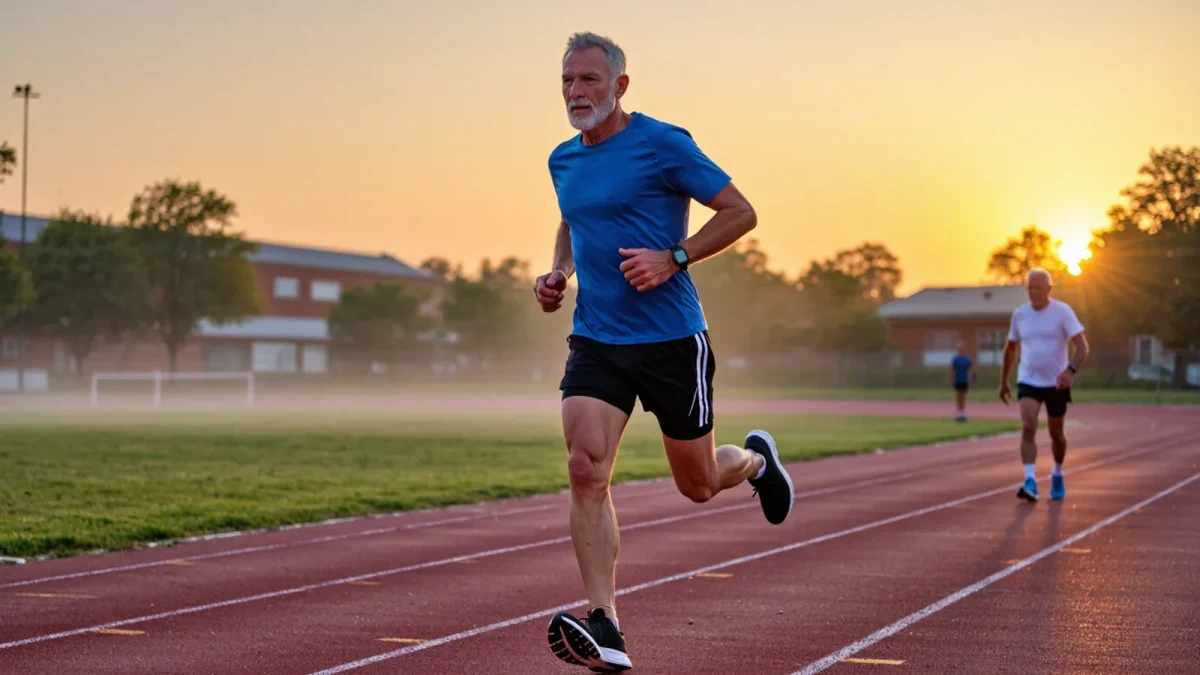
Masters athletes — generally defined as competitors over 35, with the deepest research after 40 — lose aerobic capacity at roughly 5 to 10 percent per decade, but trained athletes sit at the low end of that range and some hold near-peak performance into their late 40s. A long-running review of aging and exercise physiology by Hirofumi Tanaka and colleagues at the University of Texas at Austin concluded that a large share of "age-related" decline in the general population is actually the result of detraining, not aging itself.
ELITE SPORTS MAG publishes information, not medical or training advice. Readers making decisions about their own training and health should consult a qualified professional.
How fast does VO2 max actually decline?
VO2 max — the ceiling on how much oxygen your body can use — falls about 10 percent per decade after age 30 in sedentary adults. In longitudinal data on masters athletes, the rate is closer to 5 percent per decade before 50, then accelerates. The most-quoted study of this question is a 2011 University of Pittsburgh trial led by Vonda Wright, in which competitive masters athletes aged 40 to 81 were followed with MRI and fitness testing; athletes who kept training preserved quadriceps size and strength far better than inactive peers, though declines were not zero. The honest read: training slows the slide substantially; it does not stop it.
Is the decline mostly muscles, lungs, or the engine's plumbing?
All three, in a specific order. Research summarized by Tanaka and Douglas Seals points to a declining maximal heart rate as the largest driver of falling VO2 max — roughly one beat per minute per year — which shrinks peak cardiac output. Muscle mass matters next: adults who stop resistance training lose type II muscle fibers faster, and the Pittsburgh data show this loss is largely avoidable with load-bearing work. Lung function declines slowly and matters mainly for endurance events. A practical consequence for athletes over 40: maintaining intensity, not just volume, is what defends the top end.
Why do some masters athletes get faster with age?
Because age-group records reward efficiency and consistency, and because early-life fitness is not required. Analyses of masters track and swimming records show that the steepest performance drops occur after about 70, while athletes entering sport at 45 often improve for years simply by learning technique and pacing. Marathon data collected since the 1980s show average finish times rising only a few minutes per decade for committed runners in their 40s. The ceiling drops; the room between a beginner's current level and that ceiling stays wide.
What training adjustments does the evidence support?
The research points to three, none exotic. First, keep some high-intensity work: interval training in older adults improves VO2 max at similar relative rates to younger adults, per multiple controlled trials summarized in position statements from the American College of Sports Medicine. Second, lift heavier rather than only lighter: progressive resistance training is the intervention with the strongest evidence against sarcopenia, the age-related loss of muscle. Third, allow longer recovery between hard sessions, since repair rates slow with age — most studies of masters programming suggest results hold with two quality sessions per week rather than three or four.
Does recovery really change that much after 40?
Yes, mainly in timing rather than capacity. Older athletes still adapt to training stimuli; the adaptation window simply widens. A commonly cited figure from sports-science reviews is that muscle protein synthesis — the process that rebuilds muscle after a session — runs slower in older adults, which is why total daily protein needs rise modestly with age. Practically, masters athletes who copied a 25-year-old's seven-day microcycle frequently reported stalled progress or overuse injuries; the same athletes on a nine- or ten-day cycle recovered fully. Sleep and stress management carry more weight in the equation than any supplement.
Related stories: Sleep and Athletic Performance: What Teams Track · Athlete Retirement: What Transition Research Shows.
What about tendons, joints, and injury risk?
Tendons stiffen and heal more slowly with age, and masters athletes show higher rates of overuse injury — Achilles and patellar tendon problems in runners, shoulder issues in swimmers and throwers. General information only: the consistent findings are that gradual load progression and strength work for the surrounding muscle reduce overuse risk, while sudden spikes in volume raise it. This article is information, not medical advice; persistent pain deserves a clinical evaluation, not a self-diagnosis from a magazine.
How old is too old to compete seriously?
The record books refuse to set a limit. Masters athletes over 90 have completed marathons, and age-graded scoring — which adjusts performance for age — shows some competitors achieving age-graded results above 100 percent of the open world standard. A 2023 review in the Journal of Applied Physiology on aging and athletic performance framed it plainly: the trajectory of decline is remarkably individual, and the modifiable part — training, nutrition, sleep — remains the part athletes control.
Do sprint and distance athletes age differently?
They do, and the pattern is instructive. Analyses of masters world records and large participation datasets show sprint and power qualities declining earlier and more steeply than endurance qualities: the fastest masters sprinters lose ground from their late 30s onward, while marathon and cycling performance curves stay flatter into the late 40s. The reason is fiber type — type II fast-twitch muscle is lost faster with age than type I — plus the fact that sprinting demands the very peak outputs (maximal heart rate, rate of force development) that erode first. Distance athletes do hit a wall later: marathon participation data show performance dropping more sharply after roughly 55, when declining VO2 max finally outweighs economy and pacing skill. Power athletes who keep lifting narrow the gap considerably, which circles back to the strength finding.
Do masters athletes need more protein?
Probably a modest amount more, per the sports-nutrition position stands. Recommended daily intakes for older athletes run toward the upper end of the general athletic range — commonly cited figures are around 1.2 to 1.6 grams per kilogram of body weight per day, with some researchers in aging muscle recommending up to about 2.0 — because anabolic resistance, the muted muscle-building response to protein and training in older adults, raises the dose needed for the same effect. Distribution matters too: trials on muscle protein synthesis in older adults find that spreading protein across meals, with roughly 25 to 40 grams per meal including a leucine-rich source, outperforms the same total crammed into one dinner. The evidence is solid on mechanism and decent on meal distribution; supplements are largely unnecessary when food does the job.
How do age-graded performances work?
Age-grading is the tool that makes masters competition legible: it expresses a performance as a percentage of the best recorded mark for that age, so a 62-year-old's 5K time can be compared with a 25-year-old's. The standards come from statistical models fitted to world single-age records, refined periodically by bodies such as World Masters Athletics. Two honest caveats from the statisticians themselves: the oldest age-group standards rest on thin data, so percentages there run generous, and the models describe records, not individuals — an 80 percent age-graded performance is excellent for anyone, at any age. For tracking your own trajectory, the more useful comparison is your own age-graded score across years, which filters out most of the aging curve and shows whether the training is actually working.
The short version
Aging takes the top end slowly and takes it faster in people who stop training. Athletes over 40 who keep intensity, lift regularly, space out hard sessions, and respect longer recovery timelines retain most of their performance for decades. The averages that sound grim are averages of a mostly sedentary population.
For more context, read Endurance Fueling: The Carbohydrate Research.
For more context, read athlete retirement transition.
For more context, read The Habits That Extend Athletic Careers.