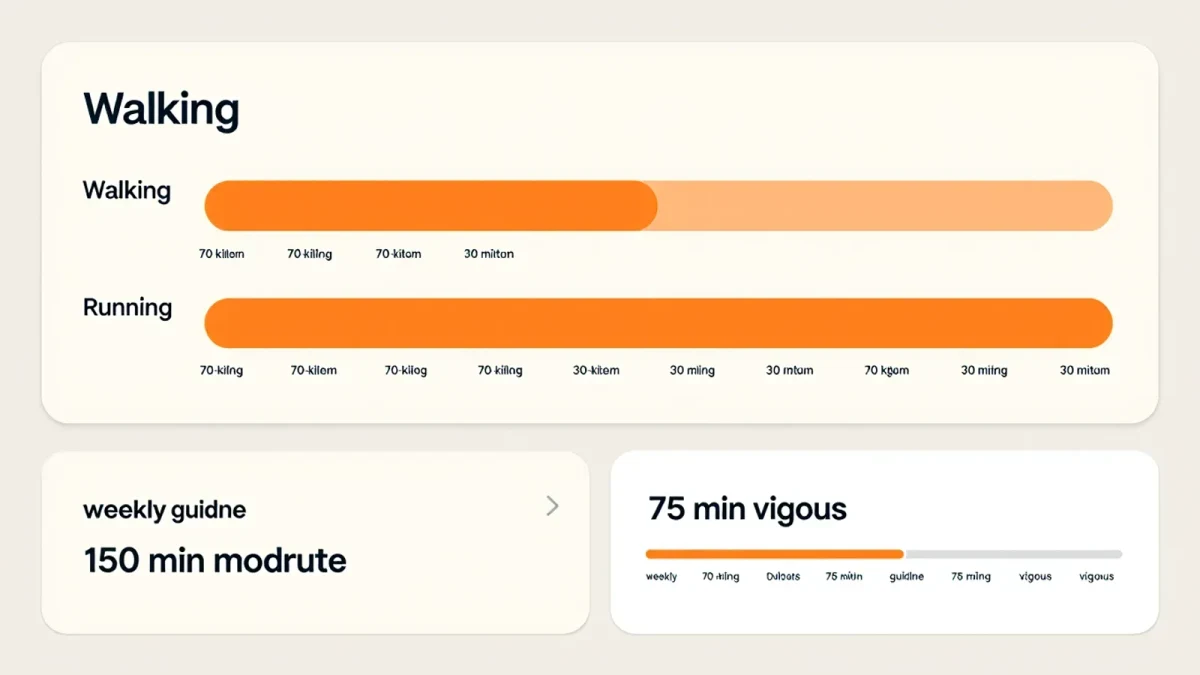
Walking vs running, measured head to head, produces a clear pattern: running builds aerobic fitness faster because it costs roughly twice as much energy per minute, while the health payoffs per calorie burned are closer than most runners assume. In research from the Lawrence Berkeley Laboratory National Runners' Health Study, led by Paul T. Williams, risk reductions for heart disease and hypertension per unit of exercise were similar between habitual walkers and runners once energy expenditure was matched. The honest answer for any individual depends on joints, schedule, and starting fitness, not on one modality winning outright.
ELITE SPORTS MAG publishes information, not medical or training advice. Readers with joint, cardiac, or metabolic conditions should consult a qualified professional before starting a running program.
Why Does Running Burn About Twice the Calories?
The economics come from physics. Running is a series of small jumps: with every stride you launch your body off the ground and absorb the landing, so the vertical work adds cost. Walking keeps at least one foot on the ground, and at typical speeds the body pivots over the stance leg like an inverted pendulum, recycling much of the energy. The result, documented in classic energy-expenditure research including studies by exercise physiologists at the University of Colorado, is that running at a moderate pace burns roughly twice the calories per mile as walking at a typical brisk pace, and the gap per minute is similar.
Speed changes the walking math only up to a point. Walking becomes progressively less efficient above about 5 miles per hour because the pendulum mechanism breaks down, which is why race walkers at elite pace work extremely hard. Below that threshold, brisk walking sits at a comfortable moderate intensity, around 3 to 6 metabolic equivalents, the band the Centers for Disease Control and Prevention defines as moderate aerobic activity.
What Did the Walker-vs-Runner Studies Actually Find?
The most cited dataset pairs two Berkeley Laboratory cohorts: tens of thousands of runners and walkers surveyed over years on habits and physician-diagnosed conditions. In a 2013 analysis in Arteriosclerosis, Thrombosis, and Vascular Biology, Williams and Paul D. Thompson reported that equivalent energy expenditure through walking and running produced broadly comparable reductions in risk for hypertension, high cholesterol, diabetes, and coronary artery disease. Walkers expending the same energy did not lag behind runners in those outcomes.
The distinction matters because runners usually expend more energy in less time. A 30-minute easy run might burn 300 calories for a 70-kilogram adult; a 30-minute brisk walk burns roughly 150. For cardiovascular risk markers, the dose appears to be the active ingredient, not the modality. For VO2 max and top-end aerobic capacity, intensity is harder to replace, and this is where running's advantage is real: walkers who never push intensity plateau at a moderate training stimulus.
Which One Builds VO2 Max Faster?
Running, for most people, and the reason is intensity ceiling. Improving VO2 max, the maximum amount of oxygen your body can use, requires elevating cardiac output close to its ceiling at least some of the time. Running makes that easy to reach; walking makes it nearly impossible for anyone with a basic fitness base. In the classic training study by Helgerud and colleagues at the Norwegian University of Science and Technology, interval running at about 90 percent of maximum heart rate improved VO2 max significantly more than the same total work at moderate intensity.
That does not sentence walkers to a flat ceiling. Incline treadmill walking, hill walking, and weighted walking can push otherwise moderate walkers into vigorous territory. Stair climbing and fast hill intervals are the walking-based equivalents of track repetitions, and studies of stair-climbing programs show meaningful aerobic gains with as little as 10 minutes of hard effort per session.
Related stories: Rucking: What the Research Actually Says · How Many HIIT Sessions Per Week? What the Evidence Supports.
What About Injury Risk?
Running is a high-impact activity, and each mile loads the legs with ground reaction forces of roughly two to three times body weight. The injury tracking literature suggests annual injury rates among recreational runners in the range of 20 to 70 percent depending on definitions, with the knee the most common site. Walking, by contrast, produces impact forces near body weight and carries a much lower injury rate in surveillance data.
Impact is not purely negative. Bone responds to loading, and weight-bearing exercise is part of the reason active populations maintain better bone density. The practical rule most coaches apply: progress running volume slowly, on the order of 10 percent or less per week, and use walking to add aerobic volume that the joints tolerate easily.
How Do the Time Requirements Compare?
The U.S. Physical Activity Guidelines set 150 minutes of moderate activity or 75 minutes of vigorous activity per week as the floor for health, and brisk walking lands squarely in the moderate column while running counts as vigorous. In other words, the guideline itself encodes the roughly two-to-one energy ratio.
| Factor | Brisk walking | Easy running |
|---|---|---|
| Calories per 30 min, 70 kg adult | ~140-170 | ~280-330 |
| Intensity classification | Moderate | Vigorous |
| Weekly guideline minimum | 150 min | 75 min |
| VO2 max ceiling | Low without hills or load | High |
| Typical injury rates | Low | Notably higher |
For a time-pressed reader, that table is the decision. Twenty-five minutes of running three times a week meets the health floor; a walker needs roughly double the clock time for the same energy dose.
Is Walking Enough for a Trained Athlete?
For trained runners and cyclists, walking is recovery, not training stimulus. Elite marathoners walk for warm-ups and cooldowns precisely because it adds blood flow without adding meaningful stress. For sedentary beginners, the calculus flips: walking is often the only aerobic work that can be sustained long enough in week one to matter, and adherence, not physiological elegance, decides who is still training in month six.
The best-supported position treats the two as tools on one spectrum rather than rivals. Walking covers the base: low cost, low risk, high adherence. Running covers intensity and time efficiency. A common combined pattern in coaching practice is easy walking volume plus one or two short running sessions, introduced after the walking base is established.
What Should Beginners Actually Start With?
The research on exercise initiation favors whichever option a person will repeat. Dropout is the dominant failure mode of fitness programs, and enjoyment is the most consistent predictor of continuation in adherence studies. A sequence that works for many adults, and matches how run-walk programs like those popularized by coach Jeff Galloway are structured, looks like this:
- Four weeks of brisk walking, 20 to 30 minutes, most days of the week.
- Run-walk intervals, one minute of easy running alternated with two minutes of walking.
- Gradual shift of the ratio until continuous easy running of 20 to 30 minutes is comfortable.
Each step keeps the stress within what tendons and joints can absorb, which is where most early running injuries originate, since cardiovascular fitness adapts faster than connective tissue.
The Verdict: Which Builds Fitness Faster?
Running does, per minute of training, roughly twofold on energy expenditure and more on aerobic ceiling. Walking builds health outcomes nearly as well per calorie, with a fraction of the injury risk, and it is the more sustainable starting point for most sedentary adults. Williams' cohorts showed that walkers who cover the same energy dose are not shortchanged on the health outcomes tracked. The faster builder and the better builder are not always the same machine, and the right choice is the one a reader can keep making in month twelve.
For more context, read Rucking: What the Research Actually Says.
For more context, read how many hiit sessions per week.