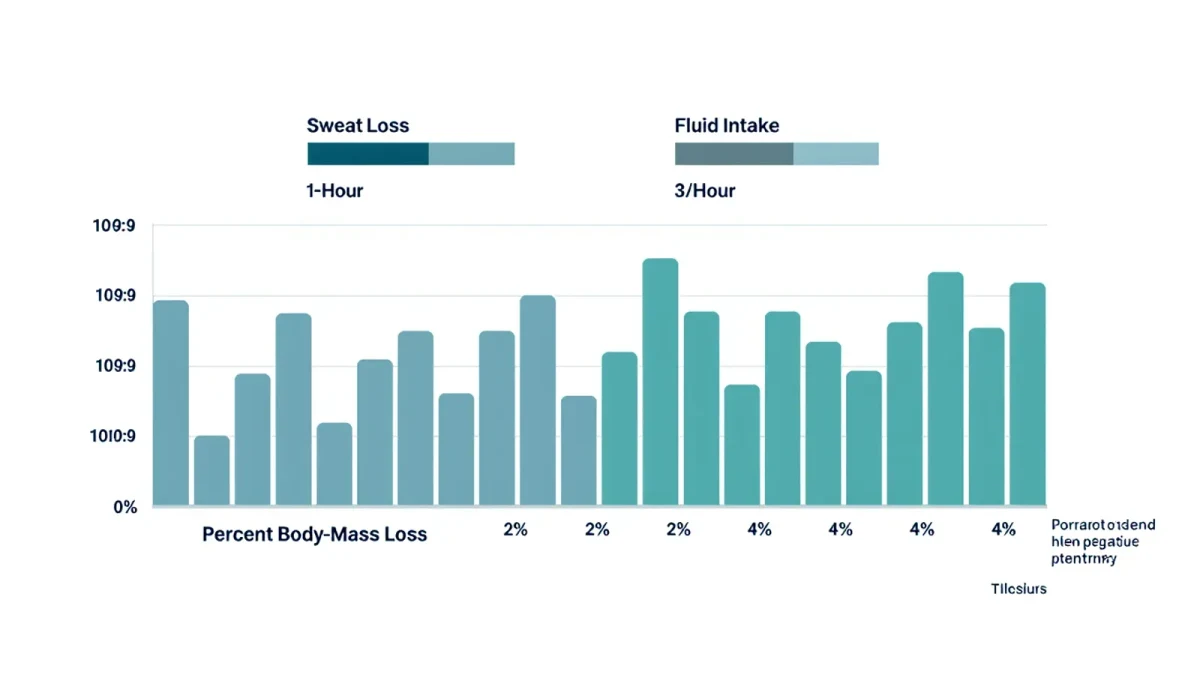
For most training under about an hour, plain water drunk to thirst is fully adequate, and the performance line the evidence keeps finding is dehydration beyond roughly 2 percent of body weight: position stands from the American College of Sports Medicine report that losses beyond that mark degrade endurance performance, especially in heat. Electrolyte drinks earn their place mainly in long sessions, hot conditions and heavy sweaters — a narrower job than the beverage aisle suggests.
This magazine publishes information, not medical advice; kidney conditions, heat illness and hydration for youth sport deserve a clinician's or qualified coach's input.
What does water actually do during exercise?
Blood plasma is mostly water, and it doubles as the cooling system: sweating moves heat out of the body via evaporating fluid drawn from plasma. Lose enough fluid and plasma volume shrinks, the heart pumps less blood per beat, core temperature climbs, and perceived effort rises at the same pace — the physiological cascade behind the 2 percent figure. In controlled laboratory trials, endurance time to exhaustion drops measurably at 3 to 4 percent body-mass loss in hot conditions.
The precise threshold varies by study, individual and sport — skill sports show performance effects at higher dehydration levels than endurance running — but the direction of the finding is consistent across decades of work.
Is drinking ahead of thirst necessary?
For events under a couple of hours, generally not. Thirst is a functioning feedback system in healthy adults, and the American College of Sports Medicine's guidance has evolved toward drinking to thirst as a reasonable default rather than forced scheduled intake. The dogma of drink-before-you're-thirsty traces partly to beverage-industry-sponsored education campaigns in the 1980s and 1990s — a lineage worth remembering when a sports drink brand also sells the hydration advice.
Where planned drinking beats thirst is ultra-endurance, multi-day events and situations — heavy sweating in extreme heat, military marches — where thirst lags losses. Even there, the plan should be modest.
Can you drink too much?
Yes, and it is more dangerous than mild dehydration. Exercise-associated hyponatremia — blood sodium diluted by excessive plain-water intake — has caused deaths in marathons, typically among slower participants who drank ahead of losses at every station. A 2005 study of Boston Marathon finishers found about 13 percent had hyponatremic sodium levels by finish, weighted toward those who gained weight during the race from over-drinking.
The prevention is unglamorous: drink to thirst, do not gain weight during an event, and prefer fluids with some sodium in very long efforts.
Related stories: Caffeine and Performance: What Dosing Research Shows · Fat Adaptation and Low-Carb Endurance: What the Science Shows.
What do electrolytes actually do?
Sodium is the one that matters in practical terms. Sweat is salty, and sodium losses of roughly 400 to 1,100 milligrams per liter of sweat — varying widely between individuals — must eventually be replaced, though ordinary meals cover most people's needs. Sodium in fluid helps maintain thirst and plasma volume during long sessions and improves palatability, which itself increases voluntary intake. Potassium, magnesium and calcium in sports drinks are present in amounts too small to affect performance acutely; they are label decoration during exercise.
Electrolyte tablets and powders are, at their core, salt delivery. That is useful for the long-and-hot scenarios and mostly unnecessary for a 45-minute gym session followed by dinner.
How much should you drink during a long session?
A defensible range supported by sports-nutrition guidance is roughly 400 to 800 milliliters per hour of actual work in the heat, scaled to sweat rate and tolerance — with the simplest personal calibration being a weigh-in: one kilogram lost equals roughly one liter of sweat. Athletes who lose more than 2 percent of body weight over their session's duration can justify a structured plan; those who lose less need little more than water to thirst.
Carbohydrate in fluid, typically 6 to 8 percent solutions, is a separate decision from electrolytes: it supplies fuel for sessions beyond about an hour, and the evidence for carbohydrate intake during prolonged endurance work is stronger than for almost any other sports-nutrition practice.
Do you need to track hydration status?
Two cheap checks cover it. Urine color — pale straw is fine, dark amber suggests catching up — and morning body weight stability across training weeks. Over-engineering daily hydration with smart bottles and constant urine color charts adds noise, not health, for recreational athletes.
Do sweat sodium losses differ between athletes?
Enormously. Tested sweat sodium concentrations in athletes range from roughly 200 to more than 2,000 milligrams per liter, and the spread is largely individual biology — fitness, heat acclimation and genetics all shift it. Heavy, salty sweaters — the athletes with white streaks on dark shirts after hard sessions — can lose several grams of sodium across a long hot event, an order of magnitude more than light sweaters.
That spread explains why one-size hydration plans misfire. A salty sweater following generic advice can under-consume sodium and cramp or fade late in long events; a light sweater following the same plan drinks and salts for a problem they do not have. Formal sweat testing, offered by several sports-science labs, pins the number for those who compete in heat; for everyone else, the salt-streak test and a weigh-in cover most of the practical ground.
Acclimation changes the equation too: after ten to fourteen days of training in heat, sweat becomes more dilute and starts earlier, which is why heat-adapted athletes need somewhat more fluid but somewhat less sodium per liter.
The bottom line
Drink to thirst for typical sessions, treat 2 percent body-mass loss as the performance line that matters, replace sodium in long hot efforts, and never drink so much plain water that you gain weight during an event. Sports drinks solve real but specific problems; water solves most of them. The research base is catalogued on PubMed.
For more context, read Fat Adaptation and Low-Carb Endurance: What the Science Shows.
For more context, read caffeine and athletic performance.
For more context, read Supercompensation: How Training Adaptation Actually Works.