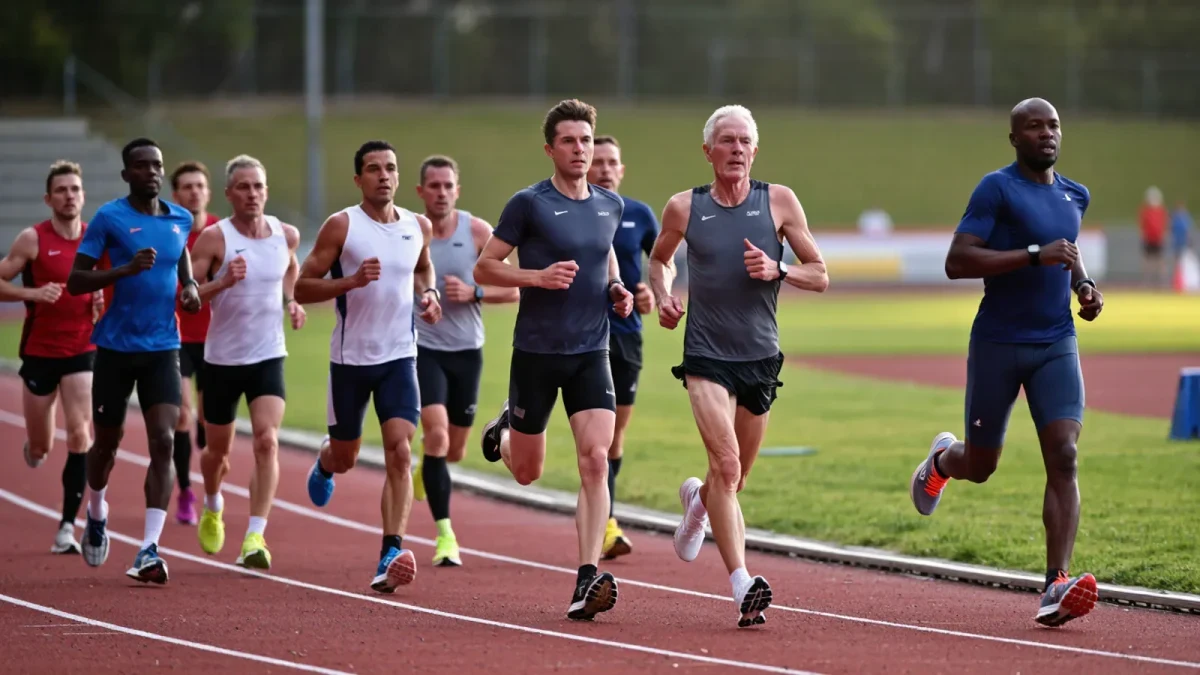
Your lactate threshold is the exercise intensity at which lactate — a fuel molecule your muscles produce constantly — starts accumulating in the blood faster than your body can clear it, and for endurance athletes it is arguably the single most trainable performance marker: well-trained runners typically raise their threshold speed far more easily than they raise their VO2 max. Sports scientists have understood since George Brooks's work on the lactate shuttle in the 1980s that lactate is produced during easy exercise too, and consumed by other muscles as an energy source.
That reframing matters for how you train. The threshold is not a wall you hit; it is a leaky balancing point between production and clearance, and both sides of the ledger respond to training.
What is lactate, and why did everyone fear it?
Lactate is a small molecule produced when carbohydrates are broken down for energy without enough oxygen — during hard efforts, but also at rest, where the body clears it continuously. The old story, dating to early-20th-century physiology, held that lactate was a toxic byproduct that caused muscles to burn and forced you to slow down. Brooks, a physiologist at the University of California, Berkeley, spent decades dismantling that story: lactate is shuttled through the blood and burned by the heart, other muscles and even the brain as fuel.
The burning legs during a hard interval come mainly from the acid produced alongside lactate metabolism, not from lactate itself — and even that association is cruder than gym lore suggests. Lactate is also a signaling molecule, telling the body to adapt.
Where exactly is the threshold?
Physiologists argue about definitions. The two most useful markers are LT1, the first point where blood lactate rises slightly above resting levels, and LT2 — often called the second lactate threshold or the maximal lactate steady state — where lactate accumulates sharply and exhaustion follows within roughly 30 to 60 minutes. Lab tests sample blood from a fingertip at increasing speeds or wattages and watch the curve bend.
Field approximations work too. For most trained athletes, LT2 sits close to the fastest pace held for one hour; for a recreational 10K runner, roughly 10K-to-hour race effort, conversational in single words but not sentences. Heart rate at threshold typically falls between 80 and 90 percent of maximum, with wide individual variation — one reason heart rate alone is a blunt tool for pinning it down.
Why is the threshold more trainable than VO2 max?
VO2 max — the ceiling on how much oxygen your body can use — responds strongly in the first months of training and then plateaus, with a large genetic component. Threshold, by contrast, keeps creeping upward for years, because it depends on trainable machinery: mitochondria that clear lactate, transporters that move it, and fatigue resistance of the muscle fibers doing the work.
The classic evidence comes from comparative physiology: elite marathoners and recreational runners can share a similar VO2 max while the elite runner's threshold sits near 85 to 90 percent of that ceiling versus the beginner's 60 to 65 percent. Same engine, different cruising speed. Studies of threshold training in already-trained cyclists and runners — among them work by researchers at the University of Lausanne's physiology department on high-intensity intervals — show threshold work shifts the lactate curve rightward within weeks in untrained subjects, and more gradually in the trained.
Related stories: Supercompensation: How Training Adaptation Actually Works · Cycle-Based Training: An Honest Review of the Evidence.
How do you train to raise it?
Three types of sessions move the number, and they work through different doors:
- Tempo or threshold runs — 20 to 40 minutes at, or a touch below, current threshold pace. The bread-and-butter session, performed at what coaches call comfortable-hard effort.
- Long intervals slightly above threshold — repetitions of 5 to 10 minutes at 5K-to-10K effort with short recoveries. These overload both production and clearance.
- A large base of easy volume — unglamorous, but mitochondrial density is built mostly by easy miles, and the threshold rises on top of that base.
A reasonable weekly structure for a trained endurance athlete is one threshold-focused session and one interval session, with everything else genuinely easy. Two hard sessions is a ceiling for most recreational athletes balancing jobs and sleep, not a starting point.
Should you get a lab test?
A stepwise blood-lactate test, available at many university physiology labs for a modest fee, gives you threshold heart rate and pace with numbers you can train against. It is most useful when you have a specific question — pacing a first marathon, checking whether your easy pace is actually easy — and less useful as a monthly ritual, since the measurement itself carries day-to-day noise of roughly 5 percent from sleep, carbohydrate intake and heat.
Wearable lactate claims deserve skepticism: wrist devices estimate a lactate threshold indirectly from pace and heart rate, and independent comparisons against blood sampling show meaningful individual error. Treat wearable numbers as a trend, not a prescription.
What does threshold training not do?
Threshold work does not replace top-end development. Sprint ability and VO2 max still need faster work, and an athlete who only trains at threshold often becomes very good at exactly one pace. Nor does raising the threshold protect against the basics going wrong: underfueling and under-sleeping blunt every adaptation a training block is meant to produce, a point documented across sports-science literature on overtraining.
The threshold is also specific to the muscle patterns used. A cyclist's bike threshold tells you little about their running threshold, because clearance machinery lives in the working muscles, not in the blood generally.
The honest bottom line
Lactate is a fuel your body makes, moves and burns, and your threshold marks the intensity where production outruns that economy. It is one of the friendliest numbers in physiology: responsive to patient work, measurable without exotic equipment, and forgiving of imperfection. A block of 8 to 12 weeks with one focused threshold session weekly, wrapped in easy volume, moves the number for most athletes — a modest, repeatable gain, which is exactly the kind the evidence can stand behind. The research base is catalogued on PubMed.
For more context, read Supercompensation: How Training Adaptation Actually Works.
For more context, read fat adaptation.
For more context, read Cycle-Based Training: An Honest Review of the Evidence.