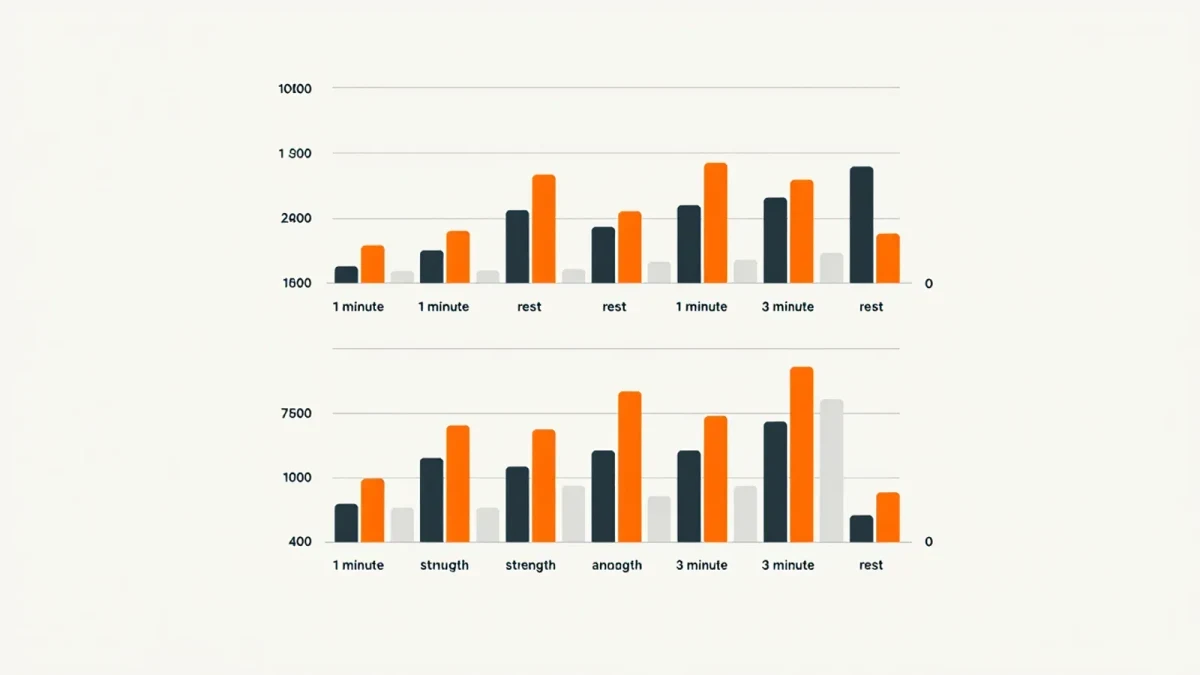
Rest between sets should run roughly two to three minutes when the goal is strength or muscle growth with heavy compound lifts, and one to two minutes on smaller isolation work — that is the practical reading of the research, and the evidence behind it is stronger than most gym lore. In a widely cited 2016 trial by Brad Schoenfeld and colleagues, trained men resting three minutes built more strength and more muscle over eight weeks than matched lifters resting one minute, and later meta-analytic work has pointed the same direction.
Longer rest is not laziness built into a program. It is one of the cheapest performance tools available, because it costs time and nothing else.
What does rest between sets actually do?
Rest determines how much of your capacity is available for the next set. Heavy lifting runs on phosphocreatine, the short-term fuel system that regenerates ATP in seconds to minutes; most of its store is replenished within about three to four minutes. Shorter rests also leave more metabolic fatigue in the muscle and more fatigue in the nervous system's ability to produce force.
The practical consequence shows up in training logs. When rest is cut to a minute on heavy compounds, the weight or reps on later sets drop — and total volume load, a key driver of adaptation, drops with it. In the 2016 Schoenfeld trial, the three-minute group simply did more total work per session than the one-minute group at the same relative intensity.
How long should you rest for strength?
For maximal strength — sets of one to five reps above roughly 85 percent of your one-rep max — two to five minutes is the standard research-supported range. A 2018 meta-analysis by Jozo Grgic and colleagues in Sports Medicine concluded that longer inter-set rest produces greater strength gains than very short rest, with the advantage attributed to fuller recovery and higher quality repetitions.
The ceiling matters too. Powerlifters peaking for a max single often take three to five minutes, and Olympic weightlifters, whose lifts demand precision under maximal load, rest similarly. Below about two minutes on true heavy work, the next set usually degrades before the muscles do.
How long should you rest for hypertrophy?
For muscle growth, the old bodybuilding habit of short rests to feel the burn has fared badly in trials. Schoenfeld's eight-week study found greater hypertrophy in the arms and thighs of the three-minute group compared with the one-minute group, a small but consistent edge measured in a modest sample of trained young men.
The likely mechanism is unromantic: longer rest preserves reps per set and volume load per session, and volume is the best-established hypertrophy driver. Short rests can still build muscle — metabolic stress is not worthless — but they build it more slowly while making each set feel worse.
When are short rests the right call?
Short rests of 30 to 60 seconds have legitimate uses. Isolation exercises for small muscle groups recover quickly, and supersets pairing unrelated muscle groups — rows with presses, for example — can cut session length substantially with little cost to either. Reviews of superset formats have found similar hypertrophy versus traditional sets when volume was equated, at the price of higher session fatigue.
Time-pressed lifters should also consider that a completed 45-minute session with paired exercises beats an abandoned 75-minute session with textbook rests. Adherence is an outcome variable too.
Related stories: How Strong Should You Actually Be? · Unilateral Training and Muscle Imbalances.
What rest ranges should you actually use?
The table below condenses the research-backed ranges by goal and exercise type.
| Goal / exercise type | Rest range | Why |
|---|---|---|
| Max strength, heavy compounds | 2-5 min | Phosphocreatine and neural recovery |
| Hypertrophy, compounds | 2-3 min | Preserves reps and volume load |
| Hypertrophy, isolation | 1-2 min | Small muscles recover quickly |
| Supersets, time-limited sessions | 30-90 sec | Session density without volume collapse |
If you have been resting by feel, try timing two training blocks: one with your habitual rests and one with the ranges above matched to your goal. Most lifters discover their rests were shorter than they thought — a pattern you can verify against the rest-interval meta-analyses indexed on PubMed.
Does resting longer mean less work per session?
It means fewer sets per hour, not less stimulus per set. If session length is fixed, longer rests force you to cut exercise count — which is usually the right trade when compounds are the priority and accessories can be supersetted afterward.
The honest summary: rest is a programming variable with real evidence behind it, not a personality trait. Set it deliberately, time it occasionally, and let the logbook settle the argument.
Does cardio training use the same rest logic?
Broadly, yes, with different clocks. Interval work aimed at raising VO2 max — the ceiling on how much oxygen your body can use — depends on recovering enough between reps to sustain near-maximal effort. Runners doing repetitions at 3,000-meter pace typically rest two to three minutes; shortening that converts the session into a slower, more acidic workout with a different training effect, not a worse one, just a different one.
Sprinters and team-sport athletes face a stricter version of the rule. Maximal sprint work depends on full phosphocreatine restoration and a fresh nervous system, so true speed sessions rest one minute for every ten meters sprinted in some coaching conventions — a full recovery standard that keeps quality high and total volume deliberately low.
The common thread across lifting and cardio: decide what the session is for, then rest long enough to keep every rep serving that purpose. Fatigue is a tool in some sessions and noise in others.
How do you time rest without watching the clock?
Gym clocks, phone timers and wearable devices all work; the failure mode is estimation. Untimed rests drift downward as a session grows hard, which is exactly when recovery matters most. A simple fix is pairing: time your rests for two weeks to calibrate your internal clock, then check it again every few blocks.
Distraction works too. Filling rest with logbook entries, walk-backs or setting up the next exercise keeps two to three minutes from feeling like dead time. What does not work is scrolling: attention drifts, rests overstay, and session quality decays in a way most lifters blame on their program.
What about rest during a fat-loss phase?
Dieting lifters have one more reason to guard their rest periods. In a caloric deficit, recovery between sets is slightly slower and the risk of losing training volume rises precisely when maintaining volume matters most for keeping muscle. Keeping rests in the two-to-three-minute range on compounds is a cheap insurance policy during a cut, even though shorter rests burn marginally more calories per hour — the trade almost always favors protecting the training stimulus and trimming calories in the kitchen instead.
For more context, read Does Slower Tempo Build More Muscle?.
For more context, read concurrent training.
For more context, read Sprint Mechanics: Faster Acceleration.