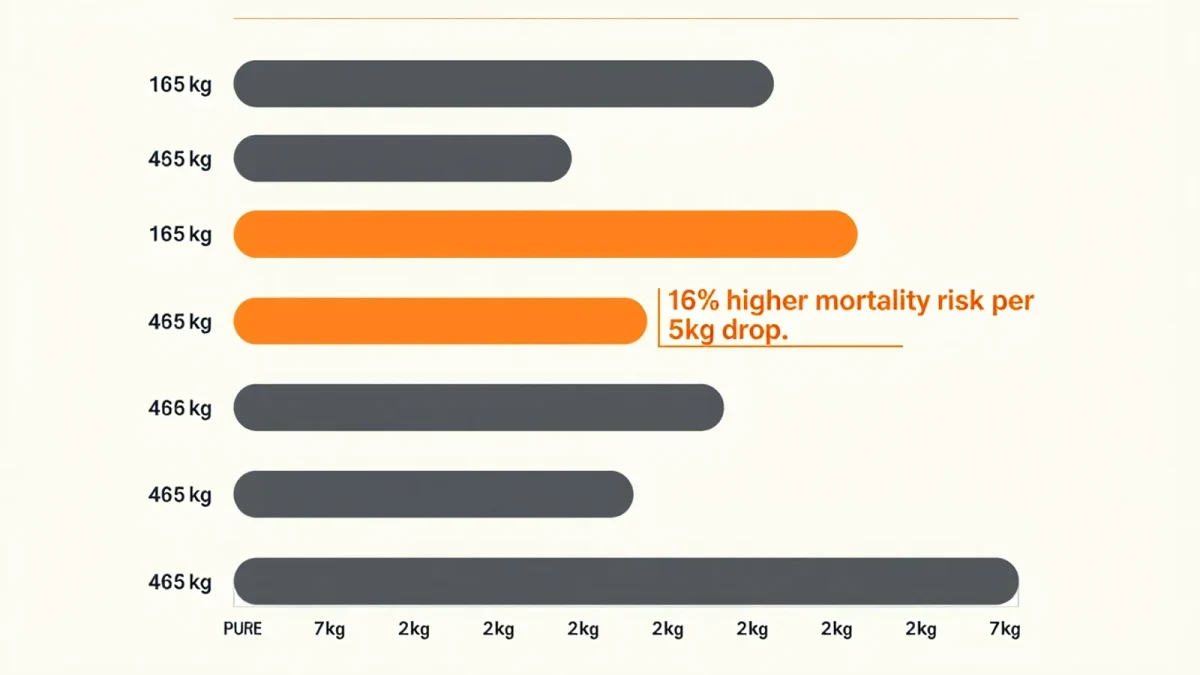
Grip strength predicts how long you live with striking accuracy: in the PURE study, which tracked roughly 140,000 adults across 17 countries and was published in The Lancet in 2015, every 5-kilogram drop in grip strength was associated with a 16 percent higher risk of death from any cause, an association that held after adjustment for age, sex, education, and employment. The measure rivaled systolic blood pressure as a predictor. The crucial caveat: grip strength is a marker, a readout of whole-body muscle mass and neuromuscular health, and the evidence does not show that training your grip alone extends life. Training your whole body, grip included, is what the strength-and-health literature actually supports.
ELITE SPORTS MAG publishes information, not medical or training advice. Grip weakness or asymmetry can have medical causes worth discussing with a qualified professional.
Where Did the Grip-Longevity Idea Come From?
Grip strength entered epidemiology because it is cheap and standardized: a hand dynamometer, a squeeze, a number in kilograms. Decades of cohort studies made that number unexpectedly informative. The PURE study, led by Darryl Leong at McMaster University and the Population Health Research Institute, provided the headline result in 2015: grip strength was inversely associated with all-cause mortality and cardiovascular mortality, and predicted outcomes better than systolic blood pressure in that cohort. The UK Biobank followed with analyses on hundreds of thousands of middle-aged adults, published by researchers including Stuart Gray and colleagues in Glasgow, linking lower grip to higher incidence of heart failure, respiratory disease, and frailty.
Clinical bodies took note. Grip testing now appears in sarcopenia diagnostic criteria, the age-related loss of muscle, used by working groups on sarcopenia in Europe and Asia, with cutoffs around 27 kilograms or less for men and 16 or less for women flagging probable low muscle function.
Why Would a Hand Squeeze Predict Lifespan?
Not because hands are special. Grip is a proxy, and its predictive power is believed to run through three channels. First, it tracks overall muscle mass and neuromuscular function: people who have stayed active and well-fueled retain grip along with everything else. Second, it shares machinery with health upstream of muscle: the same factors that damage the cardiovascular system, chronic inflammation, inactivity, poor metabolic health, erode muscle function. Third, grip reflects the capacity that matters late in life, the ability to catch yourself, carry groceries, open a jar, climb stairs, the functional reserve that determines whether a minor health event becomes a disabling one.
The correlation is honest about its own limits: observational studies cannot separate grip from the body it is attached to. No trial has shown that isolating grip training improves mortality outcomes, and none plausibly will, because grip does not cause longevity, it reports on the system.
What Counts as a Good Grip Strength Number?
Reference values vary by age, sex, and the device used, but widely used norms from large datasets, including PURE and UK Biobank analyses, place average young-adult grip near 45 to 50 kilograms for men and 27 to 30 kilograms for women, declining gradually after midlife. A rough clinical floor used in sarcopenia screening sits below about 27 kilograms for men and 16 for women.
| Group | Typical average grip | Screening concern threshold |
|---|---|---|
| Men under 40 | ~45-50 kg | Below ~27 kg |
| Women under 40 | ~27-30 kg | Below ~16 kg |
| Men 60+ | ~35-40 kg | Below ~27 kg |
| Women 60+ | ~22-25 kg | Below ~16 kg |
The most useful reading is the trend: a grip that has fallen sharply over a year deserves attention even if the absolute number looks acceptable.
Related stories: Rucking: What the Research Actually Says · Strength Training in Menopause: The Evidence on Bone and Muscle.
How Do You Train Grip, and Does It Help Anything?
For performance, yes: grip is trainable and often the weak link in pulling strength, deadlifts, rows, and carries. Climbers train it deliberately. The evidence-backed tools are unglamorous. Heavy carries, farmer's walks with substantial loads, train grip under whole-body demand and double as general strength work. Thick-bar or towel-wrapped holds, deadlifts held at the top, and timed hangs from a bar build crush and support endurance. Grip-specific spring trainers work the crushing motion, and controlled trials of hand-grip training protocols, including regimens studied for blood-pressure effects, show measurable strength gains in weeks. Because the forearm muscles involved are small and recover quickly, frequent short sessions, a few minutes most days, outperform occasional long ones, and progress shows up on the dynamometer within a month for most trainees.
One curiosity in the literature: randomized trials of isometric handgrip training, small studies aggregated in meta-analyses reviewed by bodies such as the American Heart Association's council on hypertension, have reported modest blood-pressure reductions, on the order of a few points, though the trials are small and the mechanism debated. It is a reminder that grip work sits inside general training, not beside it.
Does Grip Training Make You Live Longer?
The honest chain of evidence runs like this: strength training in midlife and beyond is associated with lower all-cause mortality in large cohorts, a finding summarized in analyses of the U.S. Physical Activity Guidelines advisory evidence and studies linking resistance exercise to mortality risk; grip strength rises with that training; and strong grippers live longer on average. What no study supports is the shortcut reading, squeezing a device while otherwise sedentary. Muscle is systemic, and the health signal appears to travel through total muscle mass, hormonal and metabolic health, and the functional capacity that keeps people moving.
The Mayo Clinic, whose patient-education materials count strength training among the highest-value activities for healthy aging, recommends resistance work for all major muscle groups twice weekly. Grip rides along for free in almost every loaded exercise, which is exactly the point: it was never a separate organ to train.
How Is Grip Actually Tested?
The standard protocol, used in PURE and most clinics, is a calibrated hand dynamometer: seated or standing with the arm at the side, elbow bent 90 degrees, two or more maximal squeezes per hand, best recorded. Home analogues, hanging from a bar for time or a bathroom-scale squeeze, are directionally useful but not comparable to norms. If a reader wants a number worth tracking, a physical therapist or sports-medicine clinic can produce a proper one in minutes, and strength coaches use the same tool to monitor training status in athletes, since grip tends to sag with fatigue.
The Bottom Line
Grip strength is one of the cheapest, best-validated vital signs in sports science: a 2015 Lancet study of 140,000 people made a 5-kilogram decline worth watching. Treat a weak or falling grip as information about the whole system and a prompt for total-body strength work, sleep, and protein, not as a call for a gadget. The squeeze is the receipt, not the purchase.
For more context, read Strength Training in Menopause: The Evidence on Bone and Muscle.
For more context, read vo2 max.
For more context, read How Much Protein Do You Actually Need to Build Muscle?.