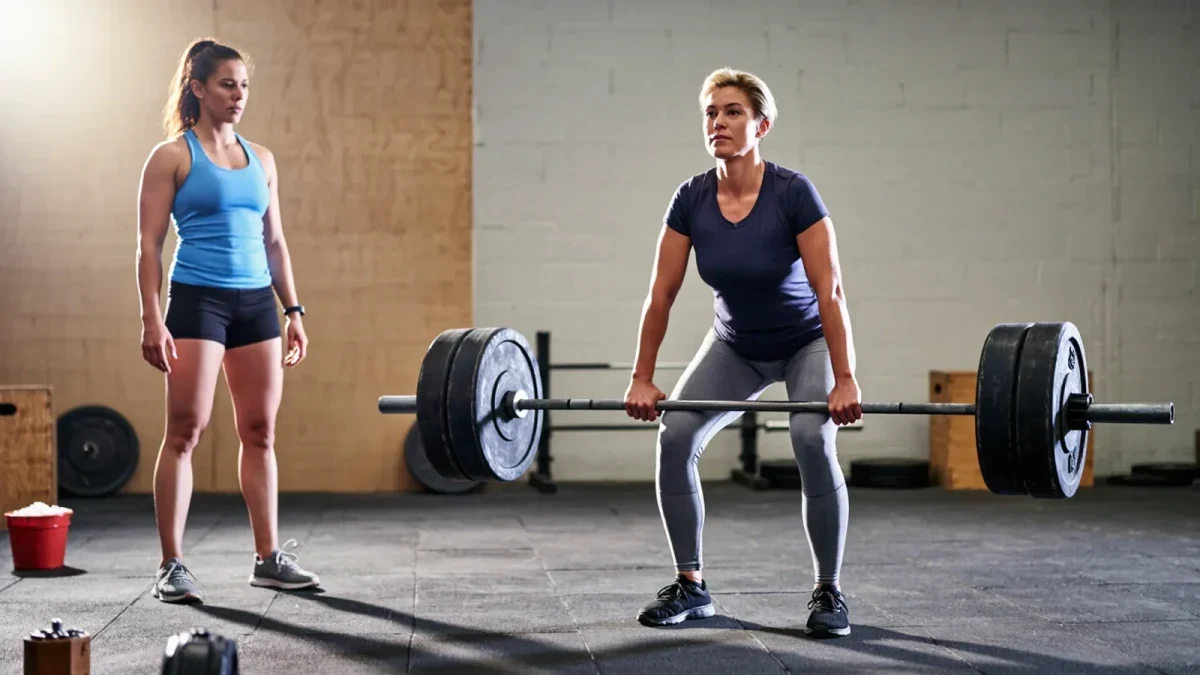
Strength training after menopause works, and the trials that show it best used genuinely heavy loads: in the LIFTMOR trial, published in the Journal of Bone and Mineral Research in 2018 by Belinda Beck and colleagues at Griffith University, postmenopausal women with low bone density who performed supervised heavy resistance training and impact exercise for eight months gained roughly 3 percent lumbar spine bone density, while non-training controls lost bone. Muscle evidence runs the same direction: menopause accelerates the loss of muscle and bone as estrogen falls, and progressive resistance training is the most consistently effective countermeasure in the literature. The qualifier is safety and supervision, not lighter weights.
ELITE SPORTS MAG publishes information, not medical or training advice. Bone density status, osteoporosis medications, and fracture risk need a qualified clinician's input.
What Changes at Menopause, Physiologically?
Estrogen decline at menopause reshapes body composition over years, not weeks. Bone resorption accelerates, women lose a meaningful share of their bone density in the years around menopause, with the fastest losses in the late perimenopausal and early postmenopausal window, and bone remains responsive to loading afterwards. Muscle mass drifts down, strength falls faster than mass, and fat mass tends to rise while resting energy expenditure sags. The mechanisms tie back to estrogen's receptors in bone, muscle, and connective tissue, which is why the menopausal transition behaves like an accelerated aging sample rather than a single event.
The reframe the research supports: this is the life stage where strength training stops being optional aesthetic work and becomes structural maintenance. Bone, in particular, responds to loading with the right stimulus, and the right stimulus is heavier than most women have been told to lift.
What Did the Bone-Density Trials Find?
The two most cited trials bracket the answer. The LIFTMOR study used supervised sessions twice weekly, five compound lifts, including deadlifts and overhead press, at intensities of 80 to 85 percent of maximum, plus impact work, and reported about 2 to 3 percent gains at the spine and hip versus losses in controls, with functional measures like back-extensor strength improving far more. Earlier work from the BEST study at the University of Arizona, a multi-year trial of weight training plus calcium in postmenopausal women, found modest density benefits at the hip and spine, on the order of 1 to 2 percent retained or gained, concentrated in women who trained hardest and longest. Meta-analyses of resistance training and bone density in postmenopausal women conclude the effect is real but modest at the spine and smaller at the hip, roughly 1 to 3 percent, and that lighter programs, machine circuits well below maximal loads, generally fail to move bone.
The dose message is blunt and repeated across studies: bone responds to heavy loads and impact, not to gentle work. Walking is good for many things, but the trials show it does little for bone density on its own.
What About Muscle and Strength?
The muscle evidence is stronger and less finicky. Resistance training trials in postmenopausal women reliably show gains in strength, on the order of 25 to 50 percent in standard measures over a few months, with measurable lean-mass change, usually a kilogram or two, far smaller than the strength gain. That strength dividend matters functionally: lower-body power is what determines stair climbing, balance recoveries, and fall avoidance, and falls, meeting fragile bone, are the mechanism by which osteoporosis becomes fracture. Reviews of exercise and fall risk in older adults, including the meta-analytic basis behind public-health recommendations for muscle-strengthening activity, place challenge-type training among the effective fall-prevention tools, especially combined with balance work.
Some research groups, notably work on power training in older adults, suggest faster concentric tempos may suit aging muscle, which loses fast-twitch capacity earliest; the trials in postmenopausal women specifically are small, but nothing in the literature contradicts lifting with intent.
Related stories: Grip Strength and Longevity: What the Research Really Shows · Zone 2 Cardio: Why Slow Training Builds Your Aerobic Base.
Is Heavy Lifting Safe for Postmenopausal Women?
With screening and progression, the trial record says yes, and it is worth being precise about what that record contains. LIFTMOR's participants trained under supervision with technique standards and graduated loading, and the program produced no training-induced fractures across its published follow-ups. The population excluded from such trials matters: women with severe osteoporosis, recent fragility fractures, or certain spinal conditions were generally not studied, and for them, clinician-guided, modified loading, sometimes starting with supervised machine work or seated variants, is the standard recommendation before progressing. The wrong conclusion from the safety data is that fragility means avoiding load; the trials show the opposite, that under-dosed training wastes the one intervention bone actually answers to.
What Should a Training Week Look Like?
Assembling the trial findings into a template for a healthy postmenopausal woman, adjusted by a professional where bone status is known:
| Component | Evidence-based dose | Why |
|---|---|---|
| Heavy compound lifts | 2 days/week, 80-85% of max, 3-5 sets | The LIFTMOR bone stimulus |
| Impact loading | Short bouts: hops, jumps, step-ups | Impact signals bone formation |
| Power intent | Lift concentric fast, lower controlled | Fast-twitch preservation |
| Balance work | 10 min, 2-3 days/week | Fall prevention |
| Protein | ~1.2-1.6 g/kg/day, spread | Supports muscle retention |
Progression beats perfection: the density gains in the trials tracked attendance and load climbed over months. Women new to lifting should expect three to six months of technique-building loads before the heavy percentages apply. Group classes can work as an anchor, but the bone stimulus in the trials came from individual, supervised barbell work, so the strength sessions deserve priority over conditioning formats that never approach the required loads. And the adherence point from the wider fitness literature applies fully here: the best-evidenced program is useless if it is abandoned, so the sustainable version of this template, kept up for years, beats an optimal one that lasts a season.
What Role Do Hormones and Medication Play?
Estrogen-based hormone therapy affects bone balance and is a medical decision outside this article's scope; guidelines from bodies such as the North American Menopause Society position exercise as an adjunct for bone health, not a replacement for pharmacotherapy when fracture risk is high. The exercise trials generally show their effects regardless of medication status, and the two stack rather than compete. Protein intake, vitamin D, and calcium status round out the non-training variables the bone literature repeatedly flags, with deficiency undercutting training adaptations.
The Bottom Line
Postmenopause is when heavy, progressive strength training earns its keep: the best trials, LIFTMOR and BEST among them, show bone gains of roughly 1 to 3 percent and large strength gains from loads at 80 percent of maximum and above, under supervision, twice a week. The gentler message women received for decades, light weights and endless walking, is the one part of the menopause toolkit the evidence never supported.
For more context, read How Much Protein Do You Actually Need to Build Muscle?.
For more context, read vo2 max.
For more context, read Rucking: What the Research Actually Says.