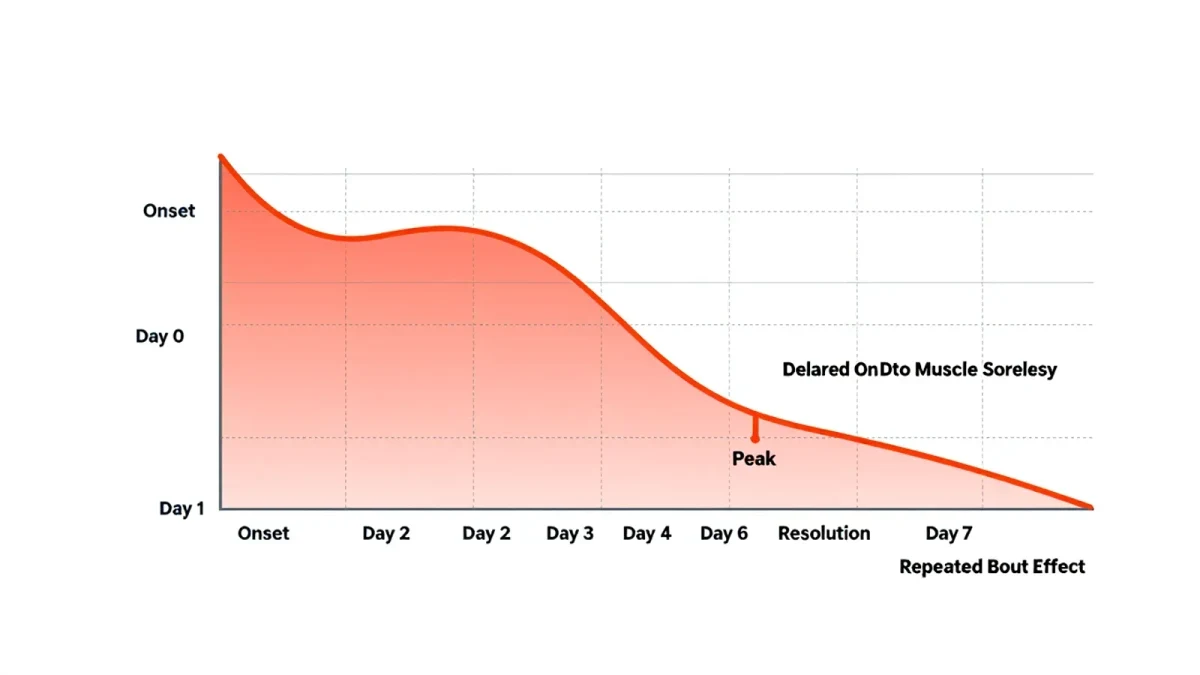
Delayed onset muscle soreness, or DOMS, is the deep muscular ache that appears 12 to 24 hours after unfamiliar exercise, peaks between 24 and 72 hours, and usually fades within a week — and decades of research have established two things clearly: it is driven by microscopic damage to muscle fibers from lengthening contractions, and soreness is a poor measure of either muscle damage or training effectiveness. Reviews of the phenomenon, including a widely cited 2003 analysis by Cheung, Hume and Maxwell, conclude that no popular treatment reliably removes it once it arrives.
That is an unpopular finding in a market full of recovery products, so it is worth walking through what the evidence actually supports.
What causes DOMS?
The trigger is well mapped. Eccentric contractions — muscles lengthening under load, as they do when lowering a weight, running downhill or braking during a sprint — generate far more fiber strain than concentric work at the same force. The strain produces microscopic tears in the z-lines of muscle fibers, followed by inflammation, fluid shifts and sensitized nerve endings in the muscle sheath. The ache is the repair process, not the damage signaling itself.
The classic demonstration is the downhill-running experiment: volunteers who ran downhill on a treadmill reported far more soreness and strength loss than those who ran flat at the same effort, because downhill gait is dominated by eccentric braking.
Why is it delayed?
The lag comes from the inflammatory timeline. Mechanical damage happens during the session, but the soreness-producing cascade — immune cells arriving, inflammatory mediators building, swelling developing — unfolds over the next one to three days. That is why you can feel fine on the evening of a hard session and struggle to sit down onto a chair two mornings later.
Peak soreness at 48 hours with resolution by day five to seven is the standard pattern reported across exercise-damage studies using untrained or unfamiliar exercises.
Is DOMS a sign of a good workout?
No, and this is the most expensive myth in the soreness literature. Muscle growth does not require soreness: studies of resistance training show hypertrophy occurs in programs that produce little DOMS once the athlete adapts, while novel exercises can produce severe soreness with minimal stimulus for growth. Soreness tracks novelty — how unfamiliar the movement and its lengthening component were — rather than how productive the session was.
A useful corollary: chasing soreness pushes athletes toward novelty for its own sake, and novel eccentric loading is precisely the profile that carries the highest strain risk per session.
What is the repeated bout effect?
The most reliable finding in the DOMS literature is that a single bout of eccentric exercise protects against soreness in later bouts of the same exercise — the repeated bout effect, documented across hundreds of studies since the 1980s. After one session of downhill running, a second session two weeks later produces markedly less soreness and less strength loss, even in untrained volunteers. The protection appears after even a few eccentric repetitions and lasts weeks to months.
The mechanism is still debated — a mix of neural adaptation, stronger connective tissue and repaired, more resilient fibers — but the practical consequence is not: introduce new eccentric-heavy work gradually, once, at modest volume, and the body handles the next exposure far better.
Related stories: The Anabolic Window, Revisited by Research · Cycle-Based Training: An Honest Review of the Evidence.
Do recovery tools actually work?
The honest ranking, based on published comparisons:
| Approach | Evidence summary |
|---|---|
| Light active recovery | Small temporary relief of soreness; no effect on muscle recovery markers |
| Massage and foam rolling | Modest short-term soreness reduction in several trials; effects on function small |
| Cold water immersion | Reduces soreness acutely; some evidence it blunts hypertrophy signaling when used after strength work |
| NSAIDs (ibuprofen etc.) | Relieve soreness but evidence suggests they can interfere with muscle repair and adaptation |
| Stretching | No preventive effect in controlled trials; brief feel-good relief at most |
Two of those rows carry a warning worth underlining. Cold water immersion after heavy resistance sessions has been shown in several trials to reduce anabolic signaling and long-term gains in muscle mass and strength, and over-the-counter anti-inflammatories may do similar work from the inside. Blunting soreness and blunting adaptation appear, uncomfortably often, to be the same lever.
How should you train around DOMS?
Sore muscles are not damaged goods in need of rest at all costs, but peak DOMS coincides with reduced strength, reduced range of motion and impaired coordination that last roughly as long as the ache. The sensible pattern used by most strength coaches: train other muscle groups or use lighter, familiar movements while soreness peaks, and let the repeated bout effect do its quiet work. Soreness that is sharp, unilateral, localized to a joint rather than the muscle belly, or accompanied by dark urine warrants medical attention — that profile is not DOMS, and this magazine publishes information, not medical advice.
Can you prevent DOMS entirely?
You can minimize it, not prevent it. A progressive warm-up, gradual introduction of eccentric loading, and consistent exposure to the movements in your program together keep soreness mild for most athletes. Graduated exposure works better than any product sold for the purpose: the repeated bout effect is free, and unlike most recovery aids, its effect size is large and repeatedly replicated.
The bottom line for athletes
DOMS is an inflammatory response to unfamiliar lengthening work, peaking at one to three days and protecting itself after the first exposure. Judge your training by performance — loads, times, rep quality — not by how sore you are, and treat recovery tools as comfort measures with real costs attached. The evidence base is catalogued on PubMed, including the Cheung, Hume and Maxwell review from 2003 that still frames the field.
For more context, read Supercompensation: How Training Adaptation Actually Works.
For more context, read What the Research Actually Says About Creatine.
For more context, read Cycle-Based Training: An Honest Review of the Evidence.