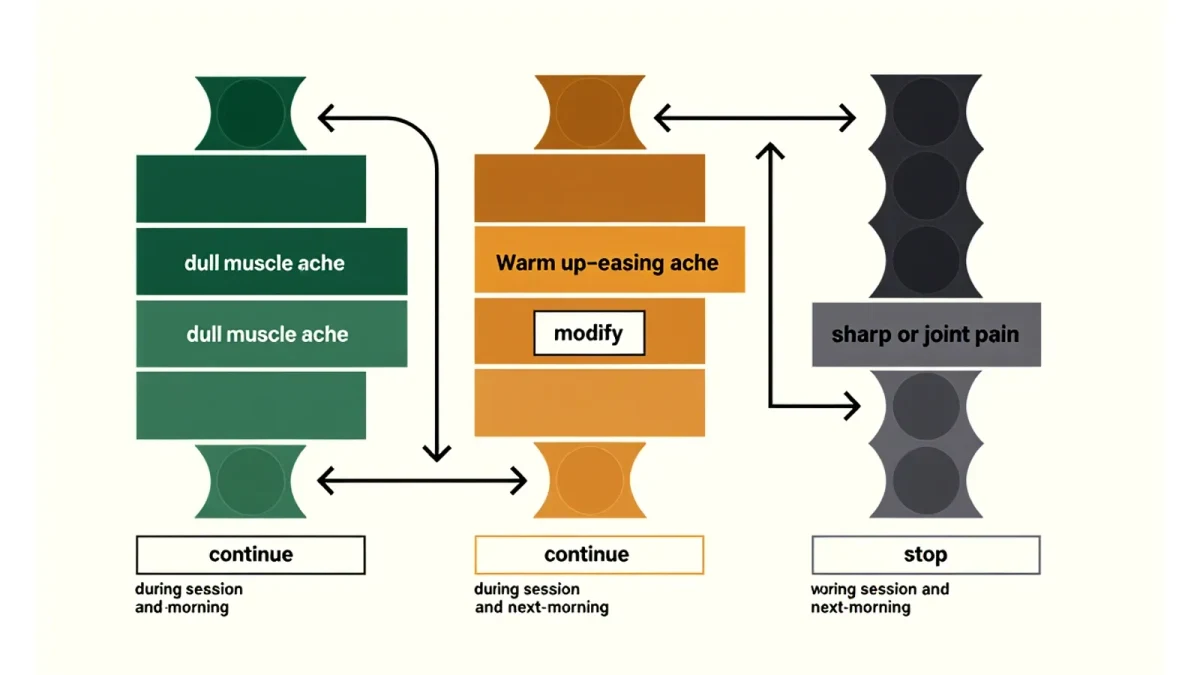
Training through minor pain is sometimes reasonable and sometimes quietly destructive, and the honest general rule from sports-medicine research is this: dull, symmetric, exercise-related muscle soreness that fades as you warm up is usually safe to work around, while sharp, localized, joint or one-sided pain that worsens during a session is a stop signal. The distinction matters more than any blanket rule, because "no pain no gain" and "never train through pain" are both wrong.
Elite Sports Mag publishes information, not medical advice, and pain is a medical topic: this article describes how clinicians and researchers categorize training-related pain, not whether your particular pain is safe to train through. For that question, see a qualified professional — especially for any severe, persistent, or post-injury pain.
How do clinicians classify training pain?
Sports-medicine practitioners commonly sort pain along a few axes: type (dull ache versus sharp or stabbing), location (widespread muscle versus a specific joint or tendon point), behavior during a session (fades as you warm up versus sharpens with load), behavior afterward (settles within a day versus wakes you at night or worsens over days), and association (follows new training stress versus arrives uninvited).
Research on pain classification in athletic settings — including work by Domhnall MacAuley's research group on assessing pain in sport — treats pain reports as data with these dimensions rather than a single yes-or-no input. The practical value for a lifter or runner is the same: writing down those five observations before deciding produces better decisions than memory and mood do.
What is normal training pain versus a warning sign?
A short list of warning signs appears across clinical guidance, including the Mayo Clinic's patient materials on sprains, strains and overuse injuries: pain that is sharp or stabbing, joint pain with swelling or instability, pain that forces technique changes, pain that persists or worsens over days, pain at rest or at night, and pain after a specific traumatic moment — a pop, a twist, a fall.
Against that, the benign list is equally short: dull symmetric muscle soreness one to two days after new stimulus, the well-documented delayed-onset muscle soreness that peaks around 24 to 48 hours; a mild ache that eases within the warm-up; and stiffness that loosens with movement. Soreness is a response to novelty, and the research on it — reviewed across dozens of DOMS studies — finds it a poor guide to either muscle damage or adaptation.
Why does some pain fade as you warm up?
Because increasing tissue temperature and blood flow, plus the analgesic effect of exercise itself, temporarily raises the pain threshold. Movement also shifts fluid, and short-term exercise-induced pain relief is a documented nervous-system effect. This is why an achy knee that eases through jogging the first ten minutes behaves differently from one that sharpens by minute five — the warm-up functions as a low-stakes test, and its result is the information.
Tendon pain sits in a subtler category: it frequently warms up and feels fine during sport, then complains more the next morning. That pattern — good during, worse after — is the classic signature of tendinopathy described in the sports-medicine literature, and the widely used PEACE and LOVE framework from a 2020 British Journal of Sports Medicine editorial by Dubois and Esculier is the current consensus frame: protect briefly, avoid aggressive anti-inflammatory interference in the earliest phase, then progressively load the tissue, because tendons adapt to load, not to rest.
Related stories: Unilateral Training and Muscle Imbalances · Does Slower Tempo Build More Muscle?.
What rules help decide on a given day?
Three questions, asked in order, cover most situations.
- Does the pain stay mild and stable during the session? A rating of zero-to-three out of ten that does not climb as load increases is, in the return-to-sport guidance used by clinicians, generally acceptable territory.
- Does technique stay clean? Pain that changes how you move — limping, shifting the bar, favoring one side — converts a small problem into a movement problem on top of it.
- Is it better, the same, or worse the next morning? The 24-hour response is the most honest feedback loop available: worse next-day pain for two sessions running means the load exceeded tissue tolerance.
Modify before you stop, in most cases: reduce load, cut range of motion to the pain-free zone, swap the aggravating exercise for a cousin — a front squat for a back squat, a flatbench press for an overhead press — and keep training everything that does not hurt. Complete rest, the PEACE and LOVE authors note, is mostly useful in the earliest days after a genuine injury, not as a default response to grumbles.
What about painkillers to train through pain?
Generally a poor trade outside professional supervision. Non-steroidal anti-inflammatories blunt the pain signal without changing the tissue's tolerance, which converts a warning light into a disconnected wire, and some evidence suggests high doses may interfere with the normal healing and adaptation processes in muscle and tendon. Training comfortably with medication masking a worsening problem is how minor issues become months-long ones. Any regular use of medication to enable training is a conversation for a clinician.
When is stopping immediately the right call?
Some signals do not warrant deliberation: a sudden pop or snap, rapid swelling, a joint that will not bear weight, deformity, numbness, or any chest pain, breathlessness or dizziness during exertion — the last group being medical emergencies rather than training decisions, as the Mayo Clinic's guidance on exercise warning signs makes plain.
Post-traumatic pain with any of those features means ending the session, not finishing the set. And pain that has persisted for more than a couple of weeks despite sensible modification has earned a professional evaluation; the earlier a genuine overuse injury is diagnosed, the shorter its rehabilitation tends to be.
How do you return after a pain flare?
Gradually, and with the same three-question test as the gauge. Start at a load you are confident is tolerable — often half of your previous working weight or distance — progress no faster than discomfort stays stable, and expect the flare to settle over days to a few weeks for simple irritations. Keep a brief log of pain ratings during and the morning after each session; return-to-play research leans on exactly this kind of monitoring, and self-coached athletes can run a small honest version of it.
The honest summary: mild, stable, improving pain during training is usually workable with modification; sharp, worsening, joint, night, or post-trauma pain is not a training variable but a reason to seek assessment. Elite Sports Mag publishes information, not medical advice; for decisions about your own pain, the qualified professional is the right next read — a good starting reference is the Mayo Clinic's overview of sprains and strains.
For more context, read The Evidence on Cold Plunges Is Thinner Than You Think.
For more context, read What the Research Says About Creatine and Muscle Growth.
For more context, read How Strong Should You Actually Be?.