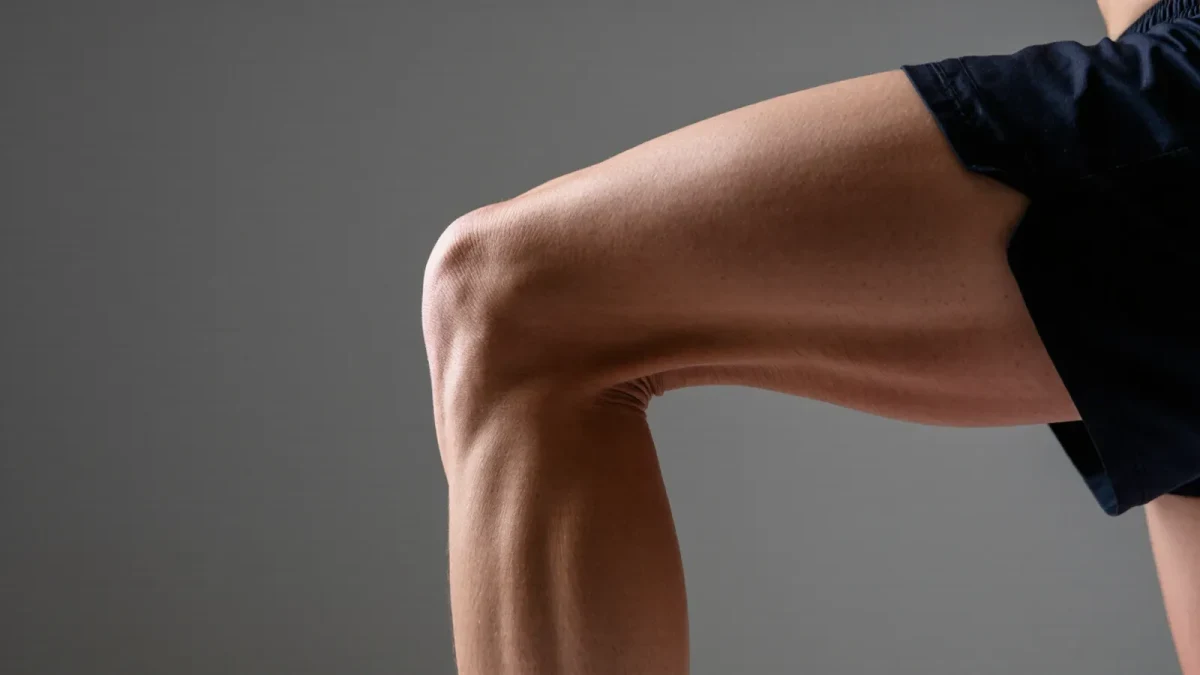
Isometric exercise, contracting a muscle without moving the joint, can produce immediate, short-lived pain relief in sore tendons, and building strength around the tendon remains the long-term fix. The landmark finding comes from Rio and colleagues' 2015 study in the British Journal of Sports Medicine, in which heavy isometric quadriceps holds, five sets of 45 seconds at about 70 percent of maximal voluntary contraction, immediately reduced patellar tendon pain in athletes, with the analgesia lasting at least 45 minutes.
This article publishes information, not medical advice. Persistent tendon pain deserves a proper diagnosis from a qualified clinician before you self-manage it.
What is tendinopathy, and why does it hurt?
Tendinopathy is the clinical term for a painful, overloaded tendon, most often the patellar tendon below the kneecap in jumping athletes, the Achilles in runners, or the elbow tendons in racket sports. It is not simple inflammation. Under the microscope, overloaded tendons show disorganized collagen structure and changes in the nerve endings within the tendon, which is why resting completely rarely resolves it: tendons adapt to load, and removing all load removes the stimulus for repair.
The practical consequence is the counterintuitive one that defines modern tendon rehabilitation: the right dose of load helps, the wrong dose hurts, and total rest merely resets the clock.
What did the isometric studies find?
Rio's 2015 work made the striking observation that a single heavy isometric session not only reduced pain for at least 45 minutes but also reduced muscle inhibition, the nervous system's reflex damping of quadriceps activation that accompanies sore tendons. For in-season athletes, that suggested a usable tool: a heavy hold before play could quiet the tendon enough to train or compete.
Follow-up work tempered and refined the picture. A pragmatic 2019 study by the same research group, indexed on PubMed, found that a simple portable isometric squat protocol reduced in-season pain in athletes with patellar tendinopathy. A 2018 study found short-duration contractions were as effective as longer holds for immediate pain relief. And research continues: a clinical trial registered on ClinicalTrials.gov (NCT07361848) is currently testing whether long-hold yielding isometrics improve pain and tendon mechanical properties.
Isometrics versus eccentrics: which is better?
Before isometrics, the standard protocol was slow, heavy eccentric loading, lowering into a squat or a heel drop over seconds, popularized by studies on Achilles and patellar tendons in the 1980s and 1990s. The current evidence does not crown a single winner. Network meta-analyses comparing eccentric, isometric and other loading programs find broadly comparable outcomes, with the decisive variables being load progression, adherence and whether the program matches the demands of the athlete's sport.
The honest synthesis used by most tendon researchers today: isometrics can be a good early-stage and pre-competition tool because they are heavy but relatively pain-quiet; eccentric and slow heavy resistance work builds capacity across the tendon's full range; and eventual return to sport requires loading at speed and under stretch, because that is what tendons actually do in games.
Related stories: What Science Says About Priming Warm-Ups Before You Sprint · What the Research Actually Says About HRV-Guided Training.
How have athletes actually used isometrics?
The classic protocol from the literature is deliberately unglamorous: a wall squat or leg extension hold at about 70 percent of maximal effort, held around 45 seconds, repeated five times with rest between, progressing the angle and load as pain allows. Runners with Achilles symptoms have used an analogous held heel raise. The point is effort, not duration to exhaustion; these are heavy, brief, controlled doses.
Two cautions recur in the literature. First, immediate pain relief is not healing, and an athlete who uses isometrics to mask pain while keeping total load unsustainable is managing symptoms, not the problem. Second, individual response varies widely, which is why supervised progression beats a downloaded protocol.
What does a sensible progression look like?
Broadly, the tendon literature supports staged loading: begin with heavy slow holds that keep pain acceptable during and settle within 24 hours, add slow full-range resistance work as tolerance grows, then reintroduce speed, jumping and change of direction before full return. Each stage keeps pain below the thresholds clinicians use to judge whether load is appropriate.
Progress is measured in weeks and months, because tendon collagen remodeling is slow. Athletes who track load and symptoms honestly, and who resist the urge to skip stages once pain quiets, are the ones the protocol seems to serve best.
When should you stop and get assessed?
Some signs sit outside a loading discussion entirely: pain that worsens over consecutive sessions, morning stiffness that grows rather than eases across rehabilitation, sudden sharp pain during a hop or sprint, or any tendon that becomes hot and swollen. Those patterns warrant clinical assessment before further loading, because they can indicate problems beyond routine overload that this article does not address.
Monitoring also works both ways. Athletes who keep a simple log of pain during, the morning after, and across a week give themselves and any clinician the one dataset that actually guides progression, and the research protocols above were all built on exactly that kind of repeated measurement rather than impression.
What is still uncertain?
Plenty. The mechanism of isometric analgesia, likely a combination of neurological pain modulation and reduced inhibition, is still debated. Whether the immediate relief predicts longer-term outcomes is unclear. And most trials study patellar tendons in jumping athletes, so extrapolation to other tendons and other sports carries real uncertainty, a limitation the researchers themselves state plainly.
What a decade of evidence supports is more modest and more useful than a miracle: heavy holds calm sore tendons in the short term, progressive loading rebuilds capacity in the long term, and the athlete's load management decides the difference between the two.
For more context, read What Science Says About Priming Warm-Ups Before You Sprint.
For more context, read hrv guided training.
For more context, read What Science Says About Beetroot Juice and Endurance.